AI & Agentic Council
We were quiet because we were building this
Today WAM becomes a founding partner in the AI & Agentics Council, launched by the Blockchain Game Alliance and Deloitte. Here is what that means, and why we said very little until we had it.
A lot of you have been asking the same thing for months. What is the plan. Why the silence. Where is WAM going.
Fair questions, and you deserve a straight answer. So here it is, together with the news that goes with it.
The last stretch was not a communication gap. It was the work. We did not want to announce a plan and then spend a year trying to catch up to our own press release. We wanted to show up already holding something real. Today is the first piece of that surfacing.
The announcement
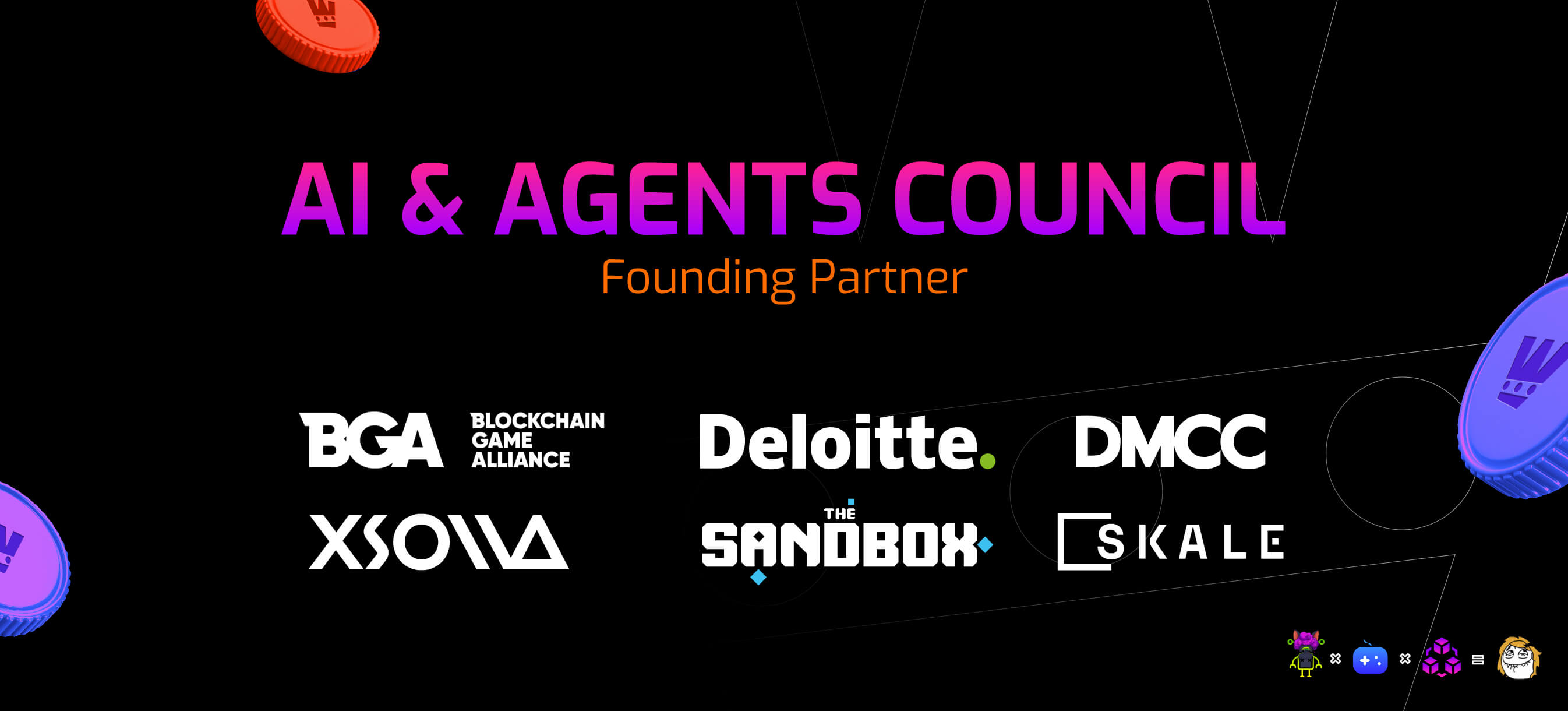
WAM is now a founding partner in the AI & Agentics Council, a new initiative launched by the Blockchain Game Alliance and Deloitte to formalize the standards for the next generation of autonomous digital actors.
The founding partners are Deloitte, Xsolla, DMCC, SKALE, The Sandbox, and WAM.
Read that list again, because the company you keep tells you what kind of table you are sitting at.
Look at who is in the room
Every partner at that table brings one layer of what autonomous agents will need in order to operate.
Deloitte, one of the Big Four, brings enterprise assurance, the trust layer that serious institutions require before they go near a new technology. Xsolla, the commerce engine behind games like Epic, Ubisoft and Valve, brings the payment rails. DMCC, the Government of Dubai's flagship free zone and one of the most awarded business authorities in the world, brings jurisdictional weight. SKALE brings gasless blockchain infrastructure built for gaming at scale. The Sandbox brings one of the largest virtual worlds in web3.
Each of them supplies a horizontal layer. Assurance. Rails. Jurisdiction. Chain. World.
WAM brings the economy they all operate in.
That is the part worth stating plainly, because it is the repositioning we want to be judged on.
Agents are not smarter players. They are economic actors.
The interesting question in this space is no longer whether an AI agent can play a game. Agents have been able to play for a while now. That question is settled and, honestly, it was never the important one.
The real question is whether an agent can act as a genuine economic participant inside a game's economy. Hold a wallet. Take a position. Back a human player with real capital. Settle the outcome on-chain, with no person in the loop.
The moment an agent can do that, something changes underneath the whole thing. A game stops being a game and becomes a market. And a market needs rules before it needs players.
That is what this council exists to write.
Why gaming, and why now
This is not a sentimental choice. Virtual worlds are the hardest test bed that exists for this kind of AI, because they demand three things at the same time that agents cannot prove anywhere else.
They demand real-time processing, where every millisecond of model latency shows up in the result. They demand persistent economies moving real capital, not test tokens in a sandbox. And they demand rational actors running 24/7, no sleep, no sentiment, putting constant pressure on the financial rails underneath.
A competitive game asks for all three at once. Very few environments do. Which is exactly why this is where the standards get stress-tested first, and why the people who set them here will shape how it works everywhere else.
We are not starting from scratch
This alliance did not begin today on an empty page.
Before this launch, the founding partners co-authored a 120-page industry report on autonomous agents in gaming and digital economies. It has already been downloaded more than 1,200 times by developers, investors, and companies trying to understand where this is heading.
Today, that research stops being research and becomes standard.
The difference matters more than it sounds. A report describes a world. A standard builds one. The move from one to the other is the exact moment scattered experiments across a dozen companies turn into shared infrastructure that people can build on with confidence. That is the moment capital stops watching from the sidelines and starts committing.
What this means for WAM
We have said for a while that the old model of play-to-earn was structurally broken, and we meant it. What we did not do was announce a replacement before it was real. We built toward one quietly instead.
This is the direction. Competitive gaming, on-chain settlement, and a new layer where AI agents act as economic participants. It is a lane very few companies in the world occupy, and holding a founding seat where its standards get written is not a badge. It is a position we intend to build from.
We are not going to over-narrate what comes next. You have heard enough promises from enough projects in this industry to last a lifetime. What we will do is keep surfacing the work as it becomes real, the same way we surfaced this.
The rest follows when it is ready, not before.
Read the full release and the report here: https://www.aiagentsingaming.com/